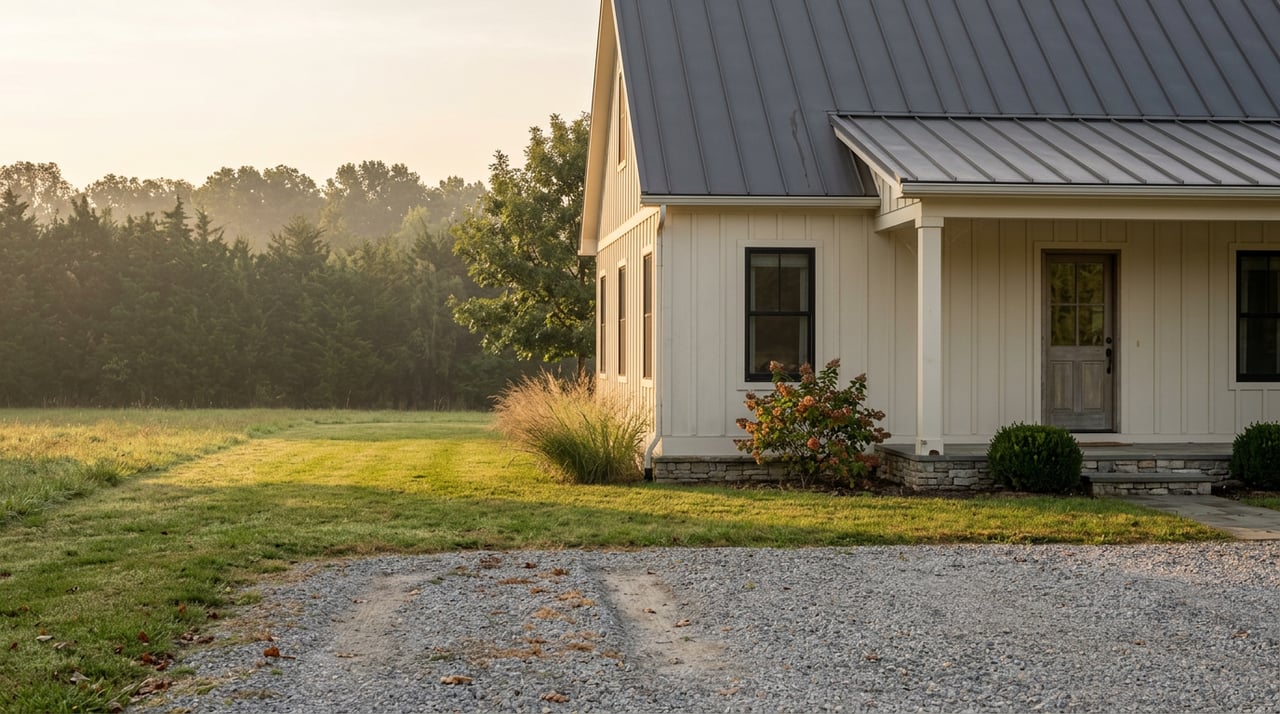
A one-acre parcel off Highway 51 in Munford closed on April 30, 2026, after 186 days on the market, for 43 percent below its original list price. Nothing was wrong with the dirt. The seller had simply priced it like land that was ready to build on now, and the market took months to agree that it wasn't, at least not yet.
That gap between what a listing implies and what a parcel can actually support shows up constantly in Tipton County right now, and Brighton is where it's easiest to miss, because the listing language and the ground underneath it can tell two different stories.
The phrase doing a lot of work
Search current listings in Brighton and you'll find raw acreage marketed as "development-ready," with descriptions promising public water and sewer are nearby, or that the parcel sits within city limits with utilities at the road through the First Utility District of Tipton County. One 125-acre tract is pitched exactly that way. A one-acre lot in Harmon Estates is offered with seller financing as low as $299 a month, framed as the lowest-entry-cost buildable parcel in the area.
None of that is false. It's also not the whole picture, because "within city limits" and "buildable" are not the same claim.
Why the county's own sewer project doesn't settle the question
It would be easy to assume that a countywide infrastructure push solves this. Tipton County, working with the City of Munford, the Town of Atoka, the Town of Brighton, and the Town of Mason, received an $8,845,865 grant to develop an asset management plan and address what state records describe as significant non-compliance in the area's wastewater systems, including infiltration and inflow problems, lagoon expansion, and lift station replacement.
That work is not finished, and it's not sitting idle either. As of mid-2026, the City of Munford has an active contract award of $710,582 tied to this effort, and the Town of Atoka has contract administration work valued at $615,424 moving through county procurement. This is real, current spending.
But read the state's own description of the purpose again: the money exists to fix non-compliance in the systems that already exist. It is not, by its own terms, a project to extend new sewer capacity out to raw acreage on the edge of town. A buyer who hears "the county just spent nearly nine million dollars on sewer" and assumes that means their acreage is closer to hookup is drawing a connection the project documents don't actually make.
What this looks like on the ground
Brighton's broader housing numbers give some sense of scale. As of this writing, the town's median home price sits at $299,999, with an average price of $310,089, and 71 homes have sold in Brighton over the trailing 12 months. That's a modest, unremarkable pace for a small town, not a market anyone would call frantic. Land carries its own separate math from finished homes, and that's exactly the point: nothing about Brighton's home-sale pace tells you whether a given acreage parcel can be built on or hooked up to sewer today. Only the parcel's own zoning and utility status answer that question.
None of this cancels out what makes Brighton genuinely attractive. The town sits roughly 35 to 45 minutes from downtown Memphis and about 47 minutes from Blue Oval City, Ford's electric truck plant slated to open in 2028, and residents who want open land and a slower pace without leaving commuting range have real reasons to look here. The point isn't that Brighton land is a bad idea. It's that the word "ready" on a listing is doing work nobody has backed up until you check.
Questions worth asking before you offer
- Which zoning district is the parcel actually in, and what does the town's code allow there today?
- Does "public water and sewer nearby" mean a line at the road with an available tap, or a line somewhere in the district with no confirmed connection point?
- Is the parcel inside the footprint of the county's current wastewater compliance work, or outside it entirely?
- What did comparable land nearby actually sell for, and how long did it sit, not what it's currently listed for?
- If the answer to any of the above is unclear, is the seller or listing agent willing to put the zoning district and utility status in writing?
FAQ
Does being inside Brighton's city limits guarantee sewer access? No. City limits and utility access are two separate facts. A parcel can sit inside Brighton and still have no confirmed connection point.
Should I avoid raw acreage in Brighton because of this? Not at all. Plenty of buyers want exactly what raw acreage offers, space, quiet, and a slower pace close to Memphis. The issue is only pricing and paperwork. Land that's genuinely served should be priced and financed differently than land that's waiting its turn.
If you're weighing acreage in Brighton against a lot in Munford or Atoka, the zoning district matters more than the listing copy, and it's worth confirming before you write an offer, not after. Dawson Realty Group works across Tipton, Shelby, and Fayette Counties and can walk the actual zoning map with you before you commit to a parcel. Contact Us to talk through what a specific piece of Brighton ground can and can't promise right now.